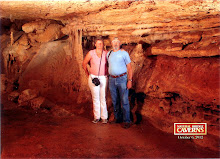
Natural Bridge Caverns

Natural Bridge Caverns
Natural Bridge Caverns, an incredible underground world of natural beauty.

TEXAS WILD FLOWERS

Monday, March 22, 2010

Arizona-Sonora Desert Museum


At Tucson Mountain Park on the way the Desert Museum.


Nothing friendlier in the desert than a Saguaro Cactus that waves hello.


The Arizona-Sonora Desert Museum is a world-renowned zoo, natural history museum and botanical garden, all in one place. The Sonoran Desert Region--an area encompassing parts of Arizona and California and the Mexican states of Sonora, Baja California, Baja California Sur, and the Sea of Cortez.


These two were in the hummingbird aviary.


A pair of White-winged Doves


Female Norther Cardinal


Male Cardinal


Black-headed Grosbeaks


Band-tailed Pigeon


Greater Roadrunner


Joshua Tree, not common to the Senoran desert, found mostly in the Mojave desert of California, Arizona, Nevada, and Utah.


Bighorn Sheep


Male center and a female lower right.


Ocelot
I think somebody wadded him up and threw him here, one could not possible get into this position by himself.


Click on the picture to open it to full screen, check it out for yourself.
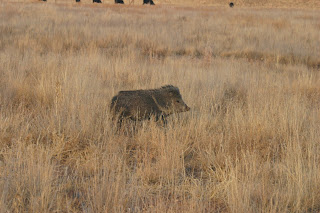


Javelina, this picture was taken on the ranch in front of the Motor home.


Bear chased a herd of them and got bit for his efforts.


This one is was taken in bow season by our neighbour. Bear won't miss it.


Check out the teeth on this guy, take a good look at those k9's. Not only are they sharp at the points, but as they open and close the mouth the k9 teeth rub against each other sharpening the sides and acting like scissors.


Looks kind of cute doesn't he. Remember this is just the head and pelt.


Javelinas, or Peccaries are medium sided animals with a superficial resemblance to pigs. Also like pigs they have feet similar to deer. There the similarities end, they have fur and other physiological differences.


Prairie dogs


Cougar, Puma, Mountain Lion


Good kitty, nice kitty, Ok, there is a health piece of glass between me on the cat.


And this would by why the Indians painted and carved Bears this way.


Tuesday, March 2, 2010

A few of my favorat shot from the ranch.

What says ranch better than a windmill.


Maybe a windmill with a rainbow.
How about horses and a rainbow.


Did I forget to mention it had snowed?
Acutely three times, but it usually melts off by noon.

Our elevation here at ranch headquarters is 4800 feet.


Looking across the ranch at the Huachuca mountains. With Miller Peak at 9500 feet there has been some snow accumulation.


The Huachuca Mountains are East of the ranch. Picture was taken at sunset.


Looking West to the Patagonia Mountains with a fresh coat of snow.


The Santa Rita mountains looking across the headquarters of the Ki He Kah Ranch.


Santa Rita's, windmill, cattle, fog, and snow, cold on the ranch. Picture taken from the road across the Vaca Ranch.


Nothing says ranch like a wind mill horses and the sun set.


Thursday, February 4, 2010

Welcome Bill and Margaret McNew


In the desert when it rains you get treated to a lot of color. This is at sunrise and that is the moon setting.


Our friends from Toutle River RV the McNews and Daisy.
There Jeep with ten miles of wet clay road all over it. Also a product of rain in the desert


We showed them the way to Parker Canyon Lake.
Picture taken from the Arizona trail head south of the lake.

Looking west from the trail head. Some of that is the Lazy J 2 Ranch. The ranch headquarters is directly west of Parker Canyon Lake.


We did not get there on paved roads.
Bill said this is the way jeeps were made to look.


Not to be out done by a sunrise of course is a sunset.

Thursday, January 21, 2010

Ever go Ostrich Fishing


The most fun I have had on a ride since Mr. Toads wild ride at Disneyland. The Tour of the Ostrich Ranch was both educational and exciting. The ride in the monster bus was a real blast.


The tour includes information about Ostriches of course, as well as the flora and Faina of Picacho Peak.


Here the Monster Tour Bus is backed up to the loading dock. No climbing ladders to get on board.


Leaving the loading dock you see Picacho Peak in the background looking very much like a volcanic neck of an extinct volcano. This is not the case however, it is the faulted, tilted, and eroded remains of a sequence of lava flows.


The male Ostrich is generally black with a white tail. These guys can weigh up to 340lb. At maturity a male Ostrich stands 6 to 9 feet tall.


Nests are scraped out by the male and will be 12 to 24 inches deep by up to 9 feet wide.


While the Ostrich is the largest bird and has the largest egg, relative to the size of the bird it is the smallest egg.


Moving on we heard a little about cactus which I have already covered in a previous post, so meat the three amigos.


Then there was ostrich fishing. Ah, like we were going to pull a 300lb bird up on a dock. Not!


So there is all the ostriches, and what you do is....


...put a quarter of a grapefruit on a big eye bolt and ...........


hang it over the side of the dock. Just like fishing right? OK, so we were just feeding them there vitamin C for the day.


Note the eye on the one closest to the grapefruit, Ostriches have a protective eye lid that's blue. They can see through this eye lid.


At 300lbs and with a brain the size of a walnut his may be were the expression " bird brain" came from.


They eat mostly seeds, shrubs, grass, and fruit.


In the wild they can be found in groups of 5 to 50.


In the yellow hat and green sweatshirt is our guide and monster bus driver, Dana. She was a grate deal of fun and leaving the fishing dock took us for a wild ride over some sand dunes.


Isn't it cute?


The eye of an ostrich is 2 inches in diameter. This helps them see predators at a greater distance. (A good thing when you could be a lions lunch.)


Back at the visitors center we found more things to feed. Like these Lorikeets, which can be a handful.


There is always one that can be a pain in the neck.


Rainbow Lorikeets are a true parrot found in many south pacific islands, southeast Asia, and Australia.
Nearly every color in the rainbow can be found in there feathers.


Then there were the burrows to feed.


No, that is not the most deformed borrow in the word. There is two borrows there going for the same treat.


You do not have to go on the tour to feed ostriches, caution, ostriches bite.


Meet the hole in the wall gang.


Eileen feeding the Fallow Deer.
Fallow Deer are native to Europe and the Middle East.
These are not fawns but adult deer, our Grate Dane Bear is larger and out weighs them by 60lbs.


Eileen elected this one the cutest because of it darker color and of course the big brown eyes.